

Skills-building an imperative for rural India too and here’s why!
A recent report from the Ministry of Labour and Employment reveals that skill-intensive occupations such as plumbing, carpentry and electrical work pay more in rural India. Shambhu Ghatak looks at the data closely to argue for greater efforts towards imparting skills, especially to rural women.
Not everyone is paid equally across various occupations under agriculture.
Between November 2013 and June 2014, the agricultural occupation for men that fetched the highest daily wage rate in rural India was logging and wood cutting, whereas the lowest daily wage rate was earned by male workers employed in animal husbandry (which includes poultry workers, dairy workers and herdsman)
This has been revealed in a recent report entitled: Wage Rates in India (2013-14), which was prepared by the Labour Bureau (Shimla/ Chandigarh) under the aegis of the Ministry of Labour & Employment.
It can be further inferred from the Labour Bureau report that certain agricultural occupations are dominated by men, such as fishing in coastal/ deep-sea regions, since no information on wage rates for female or child workers was available for these occupations.
Table 1A: All-India average daily wages rates (in Rs) in various agricultural occupations during November 2013-June 2014
| Agricultural Occupations | Male | Female | Children | Male-Female Gap | |
| 1. Ploughing/Tilling workers | 259.03 | 185.39 | @ | 73.64 | |
| 2. Sowing (including Planting/ Transplanting/ Weeding) workers | 219.51 | 179.66 | 110.68 | 39.85 | |
| 3. Harvesting/ Winnowing/ Threshing workers | 217.97 | 182.36 | 150.48 | 35.61 | |
| 4. Picking workers (including Tea, Cotton, Tobacco and other commercial crops) | 191.67 | 159.84 | 150.45 | 31.83 | |
| 5. Horticultural workers (including nursery growers) | 223.17 | 154.02 | NA | 69.15 | |
| 6. Fishermen-inland | 274.37 | 150 | NA | 124.37 | |
| 7. Fishermen-coastal/ deep-sea | 301.47 | NA | NA | 301.47 | |
| 8. Loggers and wood cutters | 304.72 | 154.84 | @ | 149.88 | |
| 9. Animal husbandry workers (including poultry workers, dairy workers and herdsman) | 178.82 | 133.8 | 77.51 | 45.02 | |
| 10. Packaging labourers, agriculture | 227.97 | 166.23 | @ | 61.74 | |
| 11. General agricultural labourers (including watering/ irrigation workers etc.) | 218.4 | 165.21 | 115.23 | 53.19 | |
| 12. Plant protection workers (applying pesticides, treating seeds etc.) | 284 | 166.7 | NA | 117.3 | |
Table 1B: All-India average daily wages rates (in Rs) in various non-agricultural occupations during November 2013-June 2014
| Non-agricultural Occupations | Male | Female | Children | Male-Female Gap |
| 1. Carpenter | 325.24 | @ | @ | 325.24 |
| 2. Blacksmith | 263.04 | 264 | @ | -0.96 |
| 3. Mason | 358.72 | 268 | @ | 90.72 |
| 4. Weavers | 237.19 | 187.55 | @ | 49.64 |
| 5. Beedi makers | 165 | 112.67 | 72 | 52.33 |
| 6. Bamboo, cane basket weavers | 213.45 | 151.05 | @ | 62.4 |
| 7. Handicraft workers | 289.14 | 143.84 | @ | 145.3 |
| 8. Plumbers | 389.13 | @ | NA | 389.13 |
| 9. Electrician | 365.43 | @ | NA | 365.43 |
| 10. Construction workers (for roads, dams, industrial & project construction work and Well diggers) | 266.19 | 187.88 | 128.69 | 78.31 |
| 11. LMV & Tractor drivers | 281.5 | @ | NA | 281.5 |
| 12. Non-agricultural labourers(including porters, loaders) | 233.86 | 171.14 | 103.06 | 62.72 |
| 13. Sweeping/ cleaning workers | 178.44 | 171.52 | 83.67 | 6.92 |
Source: Wage Rates in India (2013-14), released in 2015, Labour Bureau (Shimla/ Chandigarh),Ministry of Labour & Employment.
Note: @ means number of quotations are less than five; NA means not reported
Within all agricultural occupations, the existence of gender disparity in daily wage rates is noticeable. The highest gender gap in daily wage rates between November 2013 and June 2014 was found for logging and wood cutting, and the lowest was found among picking workers employed for tea, cotton, tobacco and other commercial crops.
Child labourers employed across different agricultural occupations earned the lowest vis-a-vis male or female adult workers. It is worth noting that although agriculture has been left out of the scope of any child labour laws, it employs more than 50 percent of India’s child labour.
NREGA wages versus agricultural wages
If we take a simple average of the MGNREGA daily wage rates in various states, as notified by the Ministry of Rural Development on 13 February 2014 (with effect from 1 April 2014), it comes to Rs. 175.83.
Table 2: State-wise wage rate (in Rs.) notified for unskilled manual workers/ MGNREGA workers in 2013-14 and 2014-15
| States | Notified daily wage rates w.e.f. 1st April 2014 | Notified daily wage rates w.e.f. 1st April 2013 |
| Assam | 167 | 152 |
| Andhra Pradesh | 169 | 149 |
| Arunachal Pradesh | 155 | 135 |
| Bihar | 158 | 138 |
| Gujarat | 167 | 147 |
| Haryana | 236 | 214 |
| Himachal Pradesh | ||
| Non-scheduled areas | 154 | 138 |
| Schedules areas | 193 | 171 |
| Jammu & Kashmir | 157 | 145 |
| Karnataka | 191 | 174 |
| Kerala | 212 | 180 |
| Madhya Pradesh | 157 | 146 |
| Maharashtra | 168 | 162 |
| Manipur | 175 | 153 |
| Meghalaya | 153 | 145 |
| Mizoram | 170 | 148 |
| Nagaland | 155 | 135 |
| Odisha | 164 | 143 |
| Punjab | 200 | 184 |
| Rajasthan | 163 | 149 |
| Sikkim | 155 | 135 |
| Tamil Nadu | 167 | 148 |
| Tripura | 155 | 135 |
| Uttar Pradesh | 156 | 142 |
| West Bengal | 169 | 151 |
| Chhattisgarh | 157 | 146 |
| Jharkhand | 158 | 138 |
| Uttarakhand | 156 | 142 |
| Goa | 195 | 178 |
| A&N Islands | ||
| Andaman district | 222 | 198 |
| Nicobar District | 235 | 210 |
| Dadra & Nagar Haveli | 182 | 175 |
| Daman & Diu | 170 | 150 |
| Lakshadweep | 195 | 166 |
| Puducherry | 167 | 148 |
| Chandigarh | 227 | 209 |
| Average wage rate | 175.83 | 157.75 |
On comparing data in Table 1A with that in Table 2, we can see that the daily wage rates prevailing for all agricultural occupations between November 2013 and June 2014 exceeded Rs. 175.83.
Similarly, if we take a simple average of the MGNREGA daily wage rates in various states as notified by the Ministry of Rural Development on 26 February 2013 (with effect from 1 April 2013), it comes to Rs. 157.75, which is less than the prevailing daily wage rates for all agricultural occupations between November 2013 and June 2014.
It has often been argued that high MGNREGA wages pushed up rural wages in India, thus, making agricultural operations costlier for landed farmers. However, as is seen from the comparison above between prevailing daily wage rates across various agricultural occupations during 2013-14 and the MGNREGA wages notified by the Government, this argument is not true.
Non-agricultural wage rates
Based on a compilation of daily wage rates collected from 600 sample villages that are spread across 20 states, the Labour Bureau report also provides daily wage rates prevailing across 13 non-agricultural occupations.
<%= insert_related_articles %>
It can be seen from Table 1Bthat among male workers employed under non-agriculture, plumbers received the highest wage rate and beedi makers earned the lowest daily wage in rural areas between November 2013 and June 2014.
Occupations such as carpentry, plumbing, electrical works and LMV & tractor driving are again dominated by men since no information on wage rates for female or child workers was available for these occupations in the present report. It may also be noted that these are the occupations, which require relatively more skill in comparison to other non-agricultural or even agricultural occupations. Therefore, it can be said that skill-intensive occupations in rural areas are by and large male-dominated.
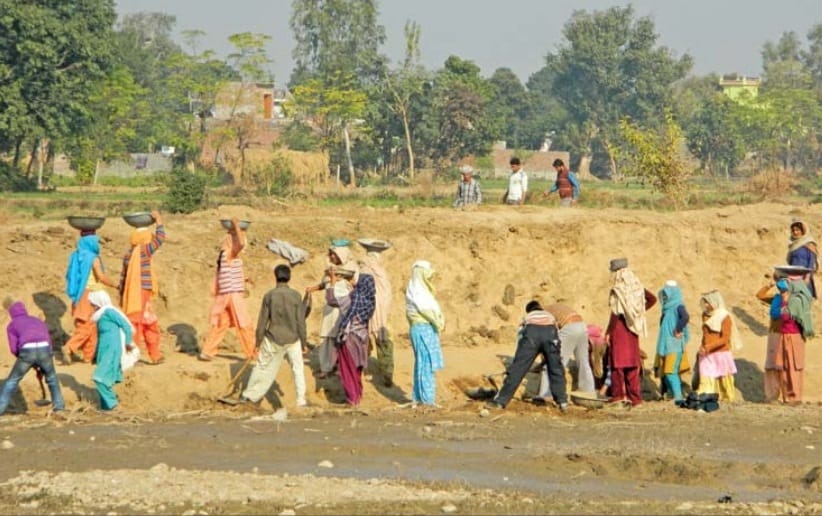
A MGNREGA site. Pic: Ministry of Rural Development, Government of India
The gender gap in daily wage rates is highest in the handicrafts industry under non-agriculture, where male workers earn almost double the wages that female workers get. In blacksmithing (i.e. metal work), daily wage rates for male and female workers are almost the same.
Workers employed in sweeping/cleaning (under non-agriculture) earned almost the same as workers employed in animal husbandry (under agriculture).
While the NDA Government wants to make India the manufacturing hub of the world through programmes such as ‘Skill India’ and ‘Make in India’, it is necessary first to take a realistic view of rural India. Instead of taking one big step forward, several small-scale, localised and innovative initiatives and interventions may prove to be more successful.
Imparting training and skill to rural women in say carpentry and electrical works can do wonders, which will improve their earning capacity. Training rural women without formal education as ‘barefoot solar engineers’ can empower them by ensuring livelihood security. It will also check migration and go a long way towards achieving rural electrification. That this is possible is already evident from the work done by the women trained as solar engineers by Barefoot College Tilonia in rural Rajasthan.
REFERENCES & READING
Wage Rates in India (2013-14), Labour Bureau (Shimla/ Chandigarh), Ministry of Labour & Employment
Notification issued by Ministry of Rural Development on 13 February 2014 on the schedule of state wise daily wage rate for unskilled manual workers.
Notification issued by Ministry of Rural Development on 26 February 2013 on the schedule of state wise daily wage rate for unskilled manual workers,
Solar mamas engineer energy security - Ranjan K Panda & Hema Yadav, The Hindu Business Line, 16 January, 2015.
Grey laws woe for child labour -Namrata Acharya, Business Standard, 19 October, 2014,
Agricultural wages and NREGA: Exploring the myth - Kanika Mahajan, Livemint, 5 November, 2012
Filed under
Cite this article
India Together (2015) ‘Skills-building an imperative for rural India too and here’s why!’, India Together, 1 May 2015. https://indiatogether.org/agricultural-and-non-agricultural-rural-wages-point-to-skills-necessity-economy/