

Eliminating child labour through participation
Collective Action for Rural Development (CAFORD) encourages families in Andhra's Prakasam district to keep their children in school.
: Sixteen year old Nagajyothi dropped out of school in the third standard. Her parents work as coolies and she is their oldest child; after she dropped out she too worked with them to supplement the family income. And then CAFORD intervened.
Founded by G Range Gowda, Collective Action For Rural Development works to eliminate child labour through a participatory approach in the rural interior of Andhra Pradesh. CAFORD organises people to solve their problems through collective action, to channelize the energies of women and youth towards development initiatives, and to provide education and health facilities with a focus on children and women. CAFORD began working with Nagajyothi and her family, counseling them on the benefits of having the children attend school. CAFORD conducted a 3-month camp, an intensive residential one, where the child was motivated and helped, to enroll herself in the 6th Std. Nagajyothi’s progress and success encouraged the parents to remove both her siblings from the work force and enroll them in the school too. Nagajyothi presently studies in the 9th Std.
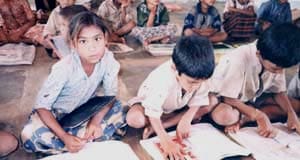
Industries are very few and the major industry is mining, slate production and processing of cashewnuts. Children are employed in the slate industry and in agriculture. The children work in chili and cotton fields too. Most of these children are employed, and even when they are not working outside their homes, they must do domestic chores and look after siblings. Typically, they have dropped out of school, or in some cases, never attended one.
CAFORD’s initiatives
- Balwadi education centers or the Pre-Primary Centers are organised and conducted in 12 villages where they follow the Montessori form of education. Training is organised for the teachers who manage the balwadis. Apart from education, to address the issue of malnutrition these children receive mid-day meals.
- The Non Formal Education (NFE) programme was implemented in 37 villages during 99-2000. Among these 37 villages, 10 NFE centers were closed as part of the plan, as child labourers in these villages was less than 2% as compared to the beginning of the programme. The 10 villages are now child labour free villages, according to the organisation.
- In order to strengthen the Village Education Committee (VEC), meetings during the year were conducted with each of the VEC in the villages. The meetings with the VECs were helpful in enrolling child labourers into schools. Public meetings were conducted in the villages that focussed on child labour, education issues and migration. Around 75 such meetings were organised during the year. Street Theatre Performances, Posters and Display of Banners were used extensively used for the purpose.
- Mothers’ are imparted health education in the area of mother and child health care, immunization and family planning. Holding its meeting regularly has strengthened the Mothers’ Committee in each of the target villages. Health awareness at the village level has increased over the years. As a result there is a considerable decline in the Infant Mortality Rate [IMR] and Maternal Mortality Rate [MMR] in the target district.
- The village women are involved in the community mobilisation process by forming Self-Help Groups (SHGs). The members are involved in education awareness programmes, education campaigns etc. Continued interaction of CAFORD staff with SHGs has now ensured that no child of any member is either sent to work or left idle at home. SHG members are very particular about enrolling their children into local schools. 24 SHGs were active in the past year through their regular meetings, savings, and credit and income generation activity.
For more information, contact:
CRY - Child Relief and You
Madhavi Mansion, 12/3-1
Bachammal Road, Cox Town, Bangalore Pin - 560 005
Email: [email removed]
Ph: 080-548 8574/ 548 4065
Fax: 080 - 548 7355
URL: www.cry.org
CAFORD’s efforts in rehabilitating child labourers in the entire district primarily through community participation has shown a positive impact. It is the continued efforts of organisations like CAFORD that will ensure that children in our country can have a healthy, happy and carefree childhood - the way every child should.
Filed under
Cite this article
Poonam Chengappa (2003) ‘Eliminating child labour through participation’, India Together, 1 February 2003. https://indiatogether.org/caford-children/