

What are you waiting for?
The Age of Consent is a clarion call to implausible action. But maybe that's the point - to urge that we ask why the obviously good outcomes seem so unlikely.
When a group organised a program opposite the World Social Forum with the protest that the WSF was “not radical enough” I asked, why aren’t you painting the walls of Reliance Industries? Are they radical enough?
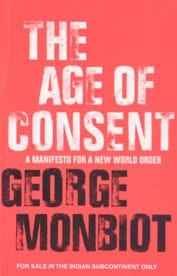
Monbiots Age of Consent appeals to those from all stripes of the Global Justice Movement seeking common goals, namely to replace the system which works for the powerful with one which works for the weak to replace a world order built on coercion with one which emerges from below, built upon democracy (p.67-68).
He evaluates the existing systems such as the United Nations, which have also been founded with such noble intentions and calls for the UN General Assembly to be democratized, capturing the powers now vested in the Security Council. Along with this he proposes a democratically elected World Parliament, and International Clearing Union for timely debt clearances and a Fair Trade Organisation. Details of these proposals draw from historical experiences and ideas which have been put forward in other times and places, which Monbiot believes deserve a chance to succeed here and now.
To popularise and reach consensus on this program Monbiot proposes to “publish pamphlets and web pages …in as many languages as we possess.” (pg. 89) The trouble is, it’s precisely those people who are most oppressed whose languages and communication technologies, knowledge paradigms are not represented in writing or in websites. A system that excluded these people would give disproportionate weight to the already powerful. While he understands that it will require extra efforts “to reach people who are illiterate,” (p. 126) is he aware that the illiterate may be trying to reach us? What efforts could we make to be better reached? Sadly, he can’t envision a scenario in which all have an equal voice or even an equal opportunity for a voice. Monbiot acknowledges, “We may have to start without some regions of the world.” (p. 93)
Missing from this manifesto is an appreciation for those who practice the solutions RIGHT NOW - without any big budgets or World Parliaments.
An immediate benefit of a manifesto that demands, as Monbiots does, to be taken seriously, due to the fine blend of passion and humility with which he argues for it, is that it generates debate, criticism and alternatives. He knows that his proposals will horrify all right thinking people yet he gets past the horror and elaborates them anyway. He is right to do this. Yet I object to the at last factor with which the manifesto is being pushed. At last the anti-globalisation movement will tell us what it is for. This is grossly unjust. Though they may not make the evening news, the rural majority of India as well as the world works every day to keep Monsanto out of their fields, the World Bank out of their pockets, and Uncle Sams war machine out of their faces, so that they may simply live. Their societies, cultures, and economies present a living alternative to globalisation. These are disappearing not to embrace modernity but simply because the spaces where they flourish are being bulldozed into oblivion.
The Age of Consent
A Manifesto for a New World Order
George Monbiot
Harper Collins 2003
Rs. 250
Can we not propose to change the world from the multiple manifestos in myriad languages of these spaces? An inexorable problem with this and numerous other such alternatives dependent on love, human kindness, and the distribution of anti-power is simply the low probability of it happening. But what do we mean by happening? On the global scale, everywhere at once? In the cities and on the information superhighway? Monbiot would perhaps argue that our solution needs to happen there as well in order to threaten those who now make war on the planet.
Is this possible? If enough people are ready to find out, why not? Hoarse from shouting slogans, on the long train and bus journeys home, in the late night chats after all the meetings, no one disputes that we need something new. To read The Age of Consent is to be provoked, and left with no excuse for inaction. Because, whether we agree with Monbiots plan or not, we cannot ignore his final question, Well, what are you waiting for? It is a question not for the “affected people” but for the dissidents among those insufficiently disturbed by the status quo to still enjoy the pleasure of reading.
Filed under
Cite this article
L S Aravinda (2004) ‘What are you waiting for?’, India Together, 1 April 2004. https://indiatogether.org/consent-reviews/