

OpinionCasteHuman RightsWest Bengal
Nandigram, an atrocity on dalits
The hypocrisy with which the Government of West Bengal acted at Nandigram this March is a serious cause of disillusionment and has opened the door to further radicalisation of the dispossessed. Tanveer Kazi presents the dalit perspective, even as the High Court continues to pass strictures on the state government.
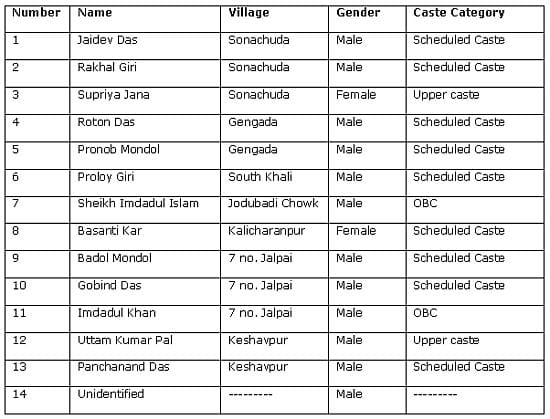
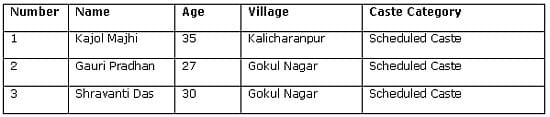
Police firing and subsequent deaths at Nandigram in March had shocked the nation. The central and state governments received a clear warning of the dangers of forcing an arbitrary SEZ policy premised on an unjust land acquisition law on the people. But seen from a dalit perspective, the violence at Nandigram was the reflection of a deeper tension that has been building up since the local residents claimed political autonomy of the area, and the state administration made a pre-meditated effort to put down the dissent with force. Police records also show that the majority of victims did indeed come from the Scheduled Castes. This is the story of Nandigram, beyond the immediate waves of the events of 14 March.
A fact-finding team from the National Campaign on Dalit Human Rights (NCDHR) gathered details through visits to Nandigram on 16 and 17 March and later from 20 to 25 April. The team engaged in conversations with the victims and their families.
Build up
On 2 January the Nandigram Block Development Office (BDO) announced the seizure of land in the area for the creation of an SEZ. The announcement was made by postings on the BDO office door and the district magistrate’s office. On 3 January a group of villagers, incensed by the news, marched on the Garchakrebia Panchayat office. The Panchayat members called the police to intervene and remove the protestors. The police arrived and lathi charged the protestors. The villagers responded by torching two police vehicles and attacking the Panchayat office.
In the ensuing violence 11 people were killed in clashes between the police and party cadres on the one side and protestors on the other. CPI(M) party members were allegedly driven from the area by the angry villagers. In the ensuing violence, one female party member was allegedly raped. The party members stationed themselves in neighbouring Khejuri and allegedly fired on protestors from across the dividing canal.
Government action
With this background the West Bengal state government decided to act to ‘restore order’ in the area. Prasad Ranjan Roy, Home Secretary of the West Bengal government, announced at Writers Building (seat of the WB Government) on 9 and 12 March 2007 that there would be police action in Nandigram. The exact numbers of how many police were mobilised are not clear - conservative figures put the number at 700 whilst others claim as many as 3,000. Along with standard lathis the police were armed with .303 rifles and semi-automatic insas assault rifles. The police were poorly equipped with non-lethal crowd dispersal equipment, an issue they have not addressed since then.
It appears that there was dispute amongst the police about the role that the CPI(M) cadres should play - whether they should form a rearguard to occupy the villages after the crowd had been dispersed or whether they should not be allowed in at all. Disturbingly, in the end, they formed the vanguard alongside the police force and what is apparent now were allowed to carry their own arms, guns as well as swords. It has even been stated by eyewitnesses that they were dressed as policemen. This decision was apparently taken by senior policemen, who decided that their knowledge of the area would be valuable to the expeditionary force.
14 March 2007
Even in the January incident, when 11 people were killed in firing, the police were poorly equipped with non-lethal crowd dispersal equipment, an issue they have not addressed since then.
The expeditionary force reached Nandigram at about 10:00am and proceeded in four columns. They faced resistance in two places; Bhangibeda (Sonachuda) and in Gokul Nagar. The protestors had anticipated a robust response from the police so had placed women and children at the front of the march to deter police from instigating violence. As the combined force approached, the protestors’ accounts differ slightly about the ensuing flow of events. What is clear is that very little time passed between arrival, any preliminary warnings and the carnage unleashed by the police. Estimates vary from between five to 15 minutes. Some accounts have the police demanding the crowd to disperse and then firing tear gas and rubber bullets followed by stone pelting and finally opening fire.
What is certain is that the legal requirement for a magistrate to be present and sign an order permitting the use of lethal force was not met. What is also apparent from all accounts is that the police gave protestors very little time and effective persuasion before opening fire especially considering the sheer number of people and therefore the logistics in clearing the crowd. All evidence points to a readiness and anticipation of opening fire with live ammunition on the crowd.
After the first rounds were fired, eyewitnesses state that as the protestors fled, the assailants chased them down the road. Survivors spoken to report seeing the brutal murders, including the beheading of a child. Our observers, who entered the village as late as 17 March, say that the streets had remnants of human blood on them for two kilometres from the site of the initial confrontation. Locals claim that 100 to 150 people were killed and party cadres were seen placing dead bodies into the back of lorries. The police suggest that 14 people were killed. Official figures differ greatly from what we gathered from the survivors, prompting suspicion amongst our observers that either party could be wildly exaggerating.
Subsequently a variety of reports have emerged suggesting serious questions about the integrity of the official figures. These include the number of rounds found in the area with also a variety of bullet types. Body parts have been unearthed, most notably the charred remains of a body in the Sonachura area. Meanwhile many families report missing relatives; some report seeing their family members falling to the police bullets. An arms cache with 800 live rounds belonging to CPI(M) members was also found in a brick kiln. Whilst the confrontation occurred, party cadres cordoned off the area to prevent press and supporters of the villagers into the area for quite some time before allowing entry.
Our observers spoke to some of the survivors and relatives in hospital. Kajili, attending to her badly beaten son in Nandigram hospital, told our team amidst tears, “I saw a child being beheaded. I could not see it anymore, and ran from there.” Other accounts taken by our team highlight wide ranging incidences of beatings and sexually harassment including that of a 55-year-old woman, who on all accounts was not a threat to ‘law and order’ or to practically anything or anyone. So traumatised was she that her relatives had to recount her tale for her. “She had fallen down on the spot; bahini (party cadres) people beat her badly, later because they did not prefer raping her, they put a stick in her genitals and mutilated them.” The team also visited a building where women had been gang raped, still littered with items of clothing.
Confirmed deaths as per police records
Women gangraped as per police records
Government response since the atrocities
The state government put forth a variety of responses. Most notably they have withdrawn the proposals for the area and the SEZ will most probably be built in Haldia, the neighbouring district. A CBI (Central Bureau of Investigation) team was one of the first to mobilise and visit the area, sent there by the Supreme Court in Kolkata. The CBI report highlighted key facts already presented here, including police and ‘outsider’ collusion and the fact that the firing was ‘unprovoked’.
The CPI(M) has responded with a variety of statements varying from denial, to counter attack and most recently limited efforts at a reconciliation process in the area. Most bizarre are statements about a U.S. collusion with protestors.
Background: SEZs and the Left
The CBI report highlighted key facts already presented here, including police and ‘outsider’ collusion and the fact that the firing was ‘unprovoked’.

Rights denuded in wordy forest
Haldia is a town and municipality in West Bengal, about 150 kilometres from Kolkata. Situated near the mouth of the Hooghly, it is a major port and is being developed more for bulk goods. In 2001, its population was 170,695. Companies operating in Haldia include Indian Oil corporation limited, Exide, Shaw Wallace, Tata Chemicals, Haldia Petrochemical and Hindustan Lever. The town is fast growing and the neighbouring district of Nandigram was thus seen as an ideal location to build an SEZ (Special Economic Zone).
The West Bengal government chose the Salim group of Indonesia for the development of the SEZ. The proposals include three SEZs that would have comprised the largest project of its kind in West Bengal with a minimum size of 250 square kilometres. Estimates as to the number of people who would be displaced by the SEZs are hard to gather.
The adoption of SEZs in West Bengal by the left front government can be seen as mimicking Chinese adoption of this policy. However, Indian SEZs appear even more aggressive than China’s. In China, the government controls the area and even owns the SEZs and they are considered more labour intensive. China has only six massive scale SEZs in areas such as Shenzen, whereas in India, an unlimited number of small SEZs are being proposed. India’s policy threatens to promote lopsided development and deter companies from investing in non-SEZ areas.
The adoption of SEZs in West Bengal is concurrent with Chief Minister Buddhadeb Battacharya’s reformist stance, whereby rhetoric is wholly outdated when compared with actions and policy. The 1 April 2007 issue of People’s Democracy, the weekly organ of the CPI (M), states: “The Bengal CPI (M) is of the firm opinion that the strong agricultural and agrarian base of Bengal should be further consolidated and extended and the state’s economy taken further forward and to newer heights through a process of pro-people industrialisation.”
Yogendra Yadav, senior fellow at the Centre for the Study of Developing Societies, New Delhi, wrote in an article in The Indian Express: “This gap between the CPI(M)‘s preaching and practice did not surprise me.” Yadav refers to Christophe Jaffrelot’s research on the social profile of MLAs in India, which shows that the proportion of upper caste MLAs is on the decline all over the country since the 1960s except in West Bengal. Here, the proportion of upper castes has increased in the state assembly after 1977, after the Left Front came to power. He points out the caste composition of successive Left Front ministries: about two thirds of the ministers come from the top three jatis (Brahman, Boddis, Kayasthas). Yadav also points to an earlier occurrence of a similar nature in West Bengal, in Alipurduar, in 1987 where CPI (M) goons attacked a peaceful, Dalit march. The peaceful protestors were then victimised by the police.
Conclusion
It is clear that the majority of victims did come from the Scheduled Castes not surprising as in the area and most parts of India the most economically vulnerable are the dalits. Lip service is all that these vulnerable communities receive in place of rehabilitation and compensation, and the same has happened in the case of land seizures too. As villager Santosh Patro reiterated to our team of the former residents of Haldia ” all those who left their land are selling cucumber and cleaning shit.”
Effectively the local residents were claiming political autonomy of the area, ridding it of party cadres and asserting themselves.
Rights denuded in wordy forest
The decision to act with such force and brutality must be seen as pre-meditated and could also be related to caste or the perceived status or lack of, of those living in the area. Effectively the local residents were claiming political autonomy of the area, ridding it of party cadres and asserting themselves. This can be seen to reflect a deeper tension that the SEZ issue finally inflamed. The response was a decidedly brutal one, in order to put residents ‘back in their place’. Terror is one of the most effective tools to manufacture submission and in this instance has already been effective; the mere sight of police was enough to disperse a crowd that had gathered after the discovery of charred remains in the area.
The hypocrisy with which the state government acted is a serious cause of disillusionment and has opened the door to further radicalisation and violence on part of the dispossessed. There have been suggestions that the resistance at Nandigram has a Maoist influence and that Naxalite rebels were planning on targeting such developments in the future. The experience of the insurgency in the adivasi communities in many eastern states, who were displaced from their ancestral homes because of the traditional mineral wealth of the region, should serve as a warning when planners contemplate land seizures of this sort.
Filed under
Cite this article
Tanveer Kazi (2007) ‘Nandigram, an atrocity on dalits’, India Together, 5 May 2007. https://indiatogether.org/nandigram-society/