

ReportEducationGirls' Education
Long and arduous road
Educationists and social scientists are increasingly veering around to the view that persistent gender biases are rooted in India's failed education system. As a result, the search for gender parity must begin with guaranteed access to quality education for all. Puja Rawat reports.
Theres a curious irony that every year March 8 is celebrated as International Womens Day with growing enthusiasm, even as the status of women in Indian society remains static, if it hasnt deteriorated. Of course in a nation which has developed a unique capability for celebrating ritual, there was no shortage of politically correct speeches on the day. Last month President A.P.J. Abdul Kalam stressed that womens rights are the edifice on which human rights stand; politicos aired their displeasure at the Jammu and Kashmirs Permanent Disqualification (Residence) Bill; Air India operated a flight with an all-woman crew and a few special women’s empowerment schemes were announced.
But beyond tokenism and displays of lachrymose sentimentality, the ground reality is this: the national male-female ratio is an alarming 1000:933; only 54.16 per cent of the women are literate; close to 15,000 women succumb to dowry torture annually and 130,000 women face the worst forms of assault upon their mental and physical well being every year.
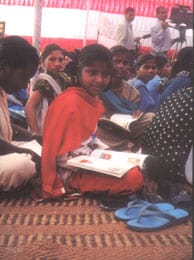
Inevitably, there is no shortage of informed opinion that education of girl children is the prerequisite of national socio-economic development. Comments UNICEFs State of the Worlds Children Report 2004: “Girls education is the most effective means of combating many of the most profound challenges to human development. Education is vital in emergencies For communities, strategies for providing girls to complete their education yields benefits for all.” Yet in the developing nations of the third world 135 million children between the ages of seven and 18 have received no education at all and of them more than 60 per cent are girl children. This gender disparity in education translates into other deprivations such as food, sanitation facilities, safe drinking water, shelter and information.
Well-known environmental activist and physicist Vandana Shiva has no hesitation in linking the issue of female education rather the lack of it to the maladies of the Indian social order. “Lack of education among women has caused the patriarchal system to grow strong roots in India. Educating women about gender equity and economic sustainability is universal education. While in the patriarchal system male education is given primary importance, womens education benefits many and is all encompassing. We should model the economy on the premise that educated women help to build equitable and sustainable societies,” says Shiva.
A growing awareness of this reality is perhaps why gender parity in education is one of the six goals of the Education For All (EFA) programme, endorsed by 164 countries at the World Education Forum in Dakar, Senegal, in 2000. The attainment of this goal by the 2015 deadline remains a distant prospect as highlighted by the 2003 EFA Monitoring Report which states that 54 countries including 16 in sub-Saharan Africa as well as Pakistan and India will fail to meet the deadline.
Against this backdrop its hardly surprising that India is positioned almost at the bottom of the heap in measures of the Gender Parity Index which traces the growth of female enrollment in schools. While a GPI of 1 indicates perfect parity between the sexes, India measures 0.83 at the primary level, a figure that is only slightly better than worse performers like Mali (0.72), Liberia (0.73) and Pakistan (0.74). And to add to this dubious distinction, India figures nowhere in the list of countries (including Nepal and Pakistan) that have shown the greatest improvement in girls enrollment.
However its important to note that although gender disparities in education are particularly accentuated in the Indian subcontinent, they are not peculiar to it.
Bias against womens education is operational worldwide in varying forms. For example in Poland, school textbooks routinely stereotype women as mothers and housewives. Likewise in Hungary most school texts dont portray women outside their home environment, and in Azerbaijan, they explicitly condemn women who work outside the home. The Indian bias against womens education dates back to the colonial period, when only a minority of upper caste and middle class women were allowed access to formal education, and even then, they were confined to separate curricula, often focused on domestic skills and moral and religious education.
The desire or motivation to send girls to school and ensure its completion is circumscribed by high economic costs, unfriendly school environments and social sanctions.
Poornima Advani, chairperson of the National Commission for Women, outlines some of the issues that plague the state of girls education in India. “While female education is of paramount importance, clearly not enough has been done on this front. Firstly, there arent enough schools for girls, and if schools are extant, electricity, toilets, buses and transport facilities are deficient.”
Niranjan Pant in his book Status of Girl Child and Women in India explains why educating the girl child remains a low national priority: “A boys education is generally viewed as a possibility of increasing the earnings and status of the family. The value of a daughters education is gauged in terms of her marriage prospects. However, marriage of an educated girl carries its own practical difficulties, and the benefits of her education in any case are seen as going to her husbands family. Therefore the desire or motivation to send girls to school and ensure its completion is circumscribed by high economic costs, unfriendly school environments and social sanctions.”
But despite a social environment which is indifferent if not hostile to womens education, within the councils of government in New Delhi there is growing awareness of the vital connection between womens education and the national development effort. In the Sixth Plan (1980-85), the eradication of illiteracy, income-generation schemes and non-formal education for poor women were accorded high priority. In the Seventh Plan (1985-90), women were identified as a critical human resource requiring skills training and development inputs. The 1992 Programme of Action, based on the National Policy of Education, 1986 and the Education for All initiative of 2003 also stressed the need for interventions for womens education and empowerment. These documents high on rhetoric, are said to herald a major shift in official policy as they acknowledge education as a prerequisite of gender equality.
IAS officer Kalpana Awasthi, Uttar Pradeshs project director, Education For All, explains the policy shift of the Union and state governments towards womens education. “From an overarching emphasis on getting all children into school, policy issues are now focusing on specific interventions such as residential camps for girls and strengthening anganwadis so that girl children arent denied education because of household duties. There is greater use of communication and advocacy tools such as kala jathas with specific targeting of messages. Ma-Beti melas, the model cluster development approach, life skill camps, and gender sensitive books are some other innovations. This new strategy is more wholesome and is devised to mobilise and empower the girl child,” says Awasthi.
Inevitably some solutions have spawned newer problems. For instance the provision for separate schools for girls has also resulted in the prescription of separate curricula for them. Despite directives of the Union government, several state governments continue to prescribe different but rarely equal curricula for girls at the school level. Girls institutions are content to have them learn home sciences, needlework and fine arts with no provision for science and mathematics. Besides disadvantaging girls in terms of career choices available to them, this also adversely affects the supply of women teachers in these subjects.
Little wonder that despite high-sounding rhetoric incorporated into the nations increasingly irrelevant five-year plans and education policy statements, on-the-ground progress in terms of empowering women through access to qualitative education has proved elusive. In rural India the gender gap in literacy is 22.27 percent and 16.8 percent in urban India. Over a third (34.3 percent) of girl children drop out before completing primary school and of the estimated 65 million out-of-school children, 40 million are girls. For states on the bottom rungs of these indicators, the numbers are terrifying. In Indias most populous state, Uttar Pradesh (pop. 160 million) only 42.98 percent of women are literate, this dips to a mere 19 percent in UPs Shravasti district. In Bihar, which is at the very bottom of the list, only 33.57 percent of girl children are literate.
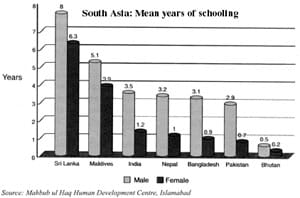
Within this overall dismal womens literacy scenario and its pertinent to note that literacy is far from being synonymous with education women within some of Indias myriad communities are doubly disadvantaged. According to an ORG-Marg Muslim Womens Survey conducted in 2000-2001 in 40 districts of 12 states, almost 60 percent of the 60 million Muslim women in the country are illiterate with the enrollment percentage of Muslim girl children being a mere 40.66 percent. As a consequence the proportion of Muslim women in higher education is a mere 3.56 per cent, lower even than that of scheduled castes (4.25 percent).
“The whole problem of mass illiteracy among women is because the Union government doesnt regard education as the fundamental right of every citizen. And it is precisely because of lack of education among women that domestic violence is a common phenomenon in Indian society. Id say more women are killed in India in cross-bedroom terrorism than soldiers on battlefields. The gravity of the issue requires it to be addressed by mainstream political parties and not merely by womens organisations. The politicisation of womens organisations is the only way towards empowerment of women,” says Brinda Karat, general secretary of the Delhi-based All India Democratic Womens Association.
The misplaced fascination of Indian educrats with numbers is also playing havoc with the cause of womens education indeed with the cause of education in general. Comments Johnson Fernandes, programme coordinator, Child Rights Unit of Yuva India, a Mumbai based NGO which runs support schools and is also involved in advocacy on childrens issues: “Under the Sarva Shiksha Abhiyan any individual who has passed class X or XII can start a school. It need not be a formal, full-time school and can be located anywhere in a temple, at home, or under a tree. The government pays this person about Rs.800 to Rs.1,000 per month. This way the government can accumulate statistics that show that all children, including the girl child are in school. This is a misdirected shortcut. Such part-time schools merely marginalise children because they dont provide even minimum quality education. These para schools actually promote child labour, because the child, especially the girl child who attends only three hours of school is free to work the rest of the time and is at a high risk of dropping out. The reality is that children in such ad hoc schools are not getting educated at all.”
Under the Sarva Shiksha Abhiyan any individual who has passed class X or XII can start a school. It need not be a formal, full-time school and can be located anywhere in a temple, at home, or under a tree. The government pays this person about Rs.800 to Rs.1,000 per month. This way the government can accumulate statistics that show that all children, including the girl child are in school. This is a misdirected shortcut. This is perhaps why Suzanne Allman, UNICEFs chief of education in India places the issue of quality of education at the top of her agenda. “Just adding numbers to muster rolls is a pointless exercise. School buildings, teacher training, resource centres and good textbooks are undoubtedly important. But so are facilitating and motivating environments. Teacher absenteeism, an unwillingness to use new methodologies, lack of enjoyable additional reading material seriously impact the quality of education. Confronted with such negative environments, even parents who want to send their daughters to school are discouraged,” says Allman.
Moreover Ray Virgilio Torres, UNICEFs representative to Uttar Pradesh, cautions against great expectations of governments. “Government is a mere component of the larger community. Therefore there is a critical need to explain what people can expect from their local or district governments. If communities can get mobilised for politics why not for education? People should understand that its not acceptable if daughters dont attend school and the community should take it upon itself to chastise offenders. Moreover it is important that grand government plans are broken into understandable targets. The common villager should know that his focus is not some aggregate enrollment figure but the little girl in his village who doesnt attend school,” says Torres.
Fortunately the tonnes of written material and informed opinions high-lighting the critical importance of educating girl children is beginning to impact Indias hide-bound educracy. A high-potential Union ministry of HRD initiative is the Mahila Samakhya (MS), which addresses the constraints which prevent girl children from accessing quality education. It provides official support to womens collectives to assist and monitor educational activities in villages.
In Uttar Pradesh MS supports welfare organisations which encourage the enrollment of women and girls in formal and non-formal education programmes in 2,066 villages in 12 districts. Among the successful initiatives driven by MS are residential literacy camps, literacy centres and Mahila Shikshan Kendras for adolescent girls who are school dropouts or have never been to school. Other initiatives include designing locally adapted and need-based curricula, newsletters and mobile libraries to reinforce learning and facilitate continuing education. Womens collectives are empowered to demand accountability from government schools with the collectives building community pressure for girls education through constant campaigning. These efforts have borne some fruit. In 332 villages covered by the MS programme, 100 percent literacy has been achieved in the six-12 years age group.
Another community-based approach which is yielding results in Indias most populous state is the year-long residential learning camp for girls. Local communities, NGOs and the state government have joined hands to ensure that girls between the ages of ten and 14 who have never experienced school are given another chance.
Meena Sharma, senior specialist at Janshala, an initiative of the UP state governments primary education department is convinced that these intensive learning programmes serve a useful purpose. “The girl child who has missed the school bus altogether cant wait for five years to complete her education. Innovations like the residential camps place her in an environment of learning 24 hours a day. Criticisms of compromise on quality of education are irrelevant, because some learning is better than absolute ignorance. Many unschooled children are appreciative of these opportunities that had been denied to them for so long.”
Similar enterprises are underway elsewhere. Magasaysay Award winner Shantha Sinha, the moving spirit behind the MV Foundation, an Andhra Pradesh based NGO believes that upward mobility can be provided to the huge number of working children in the 10-14 age group by MVF-run “bridge camps” of six-fourteen months duration. After attending MVF bridge camps, children are mainstreamed into formal schools. According to Sinha this accelerated learning programme, if replicated across the country, could provide a major breakthrough in getting children out of work and into school.
Although these initiatives are belated and few and far between, they have served the very useful purpose of building a societal consensus on the need to educate girl children in the larger national interest. Simultaneously there is an emerging consensus that instead of flogging the almost dead horse that is the government educracy, support to the cause of womens education has to come in the form of parental and community involvement, low cost and flexible timetables, new curricula which avoid gender stereotypes, schools closer to home with more female teachers and early childhood care to boost the self esteem of girl children and prepare them for school.
“Though community initiatives are crucial to ensure that the girl child avails of her fundamental right to education, central and state governments also have important roles to play. They should take immediate steps to implement the right to education and enforce the law relating to minimum age of marriage especially in north India. Moreover in schools and classrooms, administrators and teachers should be sensitised to the needs of girl children. For example proper toilets and other basic facilities which ensure the privacy and dignity of school girls would go a long way in encouraging them to enroll and remain in school,” says Dr. A.R. Vasavi, fellow in the sociology and social anthropology department of the National Institute of Advanced Studies, Bangalore.
Given the inexplicable neglect of elementary education and particularly education of the girl child in post-independence India for which the nation is paying a heavy price, the road to gender parity is likely to prove long and arduous. But if India is ever to join the league of developed nations its a road that will have to be travelled quickly. Fortunately a national consensus has emerged that getting every girl child in school is the prerequisite for breaking the cycle of inter-generational poverty and deprivation, halting the spread of killer diseases, ensuring better lives for generations to come, and creating an equitable social order. In short, towards creating a new India fit for the 21st century.
Filed under
Cite this article
Puja Rawat (2004) ‘Long and arduous road’, India Together, 1 April 2004. https://indiatogether.org/parity-education/