

Kerala revises controversial school textbook
The K N Panikkar committee recommended a change in a controversial chapter of a social sciences textbook that triggered violent agitation on the grounds that it promoted atheism and communism. P N Venugopal has more.
Four months ago, Kerala was rocked by an agitation demanding the withdrawal of the Social Science textbook prescribed for the VII standard, alleging that the second lesson in the textbook promoted atheism and communism.
The agitation which turned violent was led by the Kerala Students Union (KSU), the students wing of the Congress party, the opposition United Democratic Front (UDF), the Bharatiya Janata Party (BJP), the Christian church and organisations, the Muslim clergy and organisations and the Nair Service Society (NSS), a dominant caste organization.
The government refused to withdraw the book and in an attempt for reconciliation appointed an 18-member committee to study the issue.
The forces which had aligned against the textbook, are not happy with the changes. But the agitation has lost its steam.

Textbook turns into political row
Gujarat textbook: biases and errors
The committee headed by Dr K N Panikkar recommended in its final report submitted on 17th October that the textbook need not be withdrawn and that the controversial chapter be taught with the changes it had recommended in its interim report. Accordingly, the State Council of Educational Research and Training (SCERT) has revised the lesson, reprinted the pages and the same has been supplied to all the schools free of cost.
Following are the changes that has been made:
The title Religionless Jeevan has been changed to Freedom of Belief. All the names viz: Jeevan, Anvar Rashid and Laksmi Devi have been deleted. Now the relevant passage reads:
After filling up the names of the student and his parents, the headmaster asked:
“Which religion should we note”?
“No need to note any.
“Caste?”
“The same.”
The headmaster leaned back on his chair and asked rather gravely: “What if he feels the need for a religion when he grows up?”
“He can choose his religion if and when he feels so.”
Yes that too is possible.
This is followed by a quote from the constitution as to what it says about secularism. The quote from Nehrus testament has been replaced by a quote from one of his speeches, where he says that secularism is not the denial of religion, but the right to follow any belief of ones choice. The only other change in the text is the insertion of a quote from Sree Narayana Guru, the great social reformer of Kerala: A good human being is what matters, whatever the religion.
In contrast, here is the original passage.
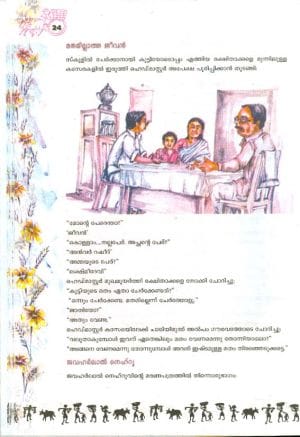
“Son, whats your name?”
“Jeevan”.
“Good nice name. Fathers name?”
“Anvar Rasheed”.
“Mothers name?”
“Lakshmi Devi”.
The headmaster looked at the parents and asked: “Which religion should we note”?
“No need to note any. Please mention no religion.”
“Caste?”
“The same.”
The headmaster leaned back on his chair and asked rather gravely: “What if he feels the need for a religion when he grows up?”
“He can choose his religion if and when he feels so.”
People comparing the revised version with the old passage say that the message is still the same.
The message that lesson tried to convey was that one does not have to be bound by the chains of religions or the incident of ones birth; but is free to live a life of ones own choice, says Dr R V G Menon, a renowned educationist. I dont think that the changes that have been made dilutes that message, he adds.
Sr Brijit, teacher, St John De Britto High School, Fort Cochin concurs with the opinion that the message has not changed. But her perspective is slightly different. The changes are only cosmetic and the original intent has been retained.
The forces, which had aligned against the textbook, are not happy with the changes. But the agitation had lost its steam with the death of 48-year-old James Augustine, a teacher, two months ago. Augustine was assaulted by the protestors at Kuzhissery in Malappuram district where he had come to attend a monthly teachers training programme and the general reaction against the agitation reached its pinnacle.
The Kerala society has apparently moved on to other issues.
Filed under
Cite this article
P N Venugopal (2008) ‘Kerala revises controversial school textbook’, India Together, 9 November 2008. https://indiatogether.org/textbook-education--2/